
SEARCH
MESSAGE

For an ejiao block, the certificates and test reports matter only if they can answer three questions clearly: what the material is, where it came from, and whether the finished block meets a defined quality specification. A document set that only repeats marketing language is weak evidence. A useful file set should link the raw material, the processing route, and the release status of each batch.
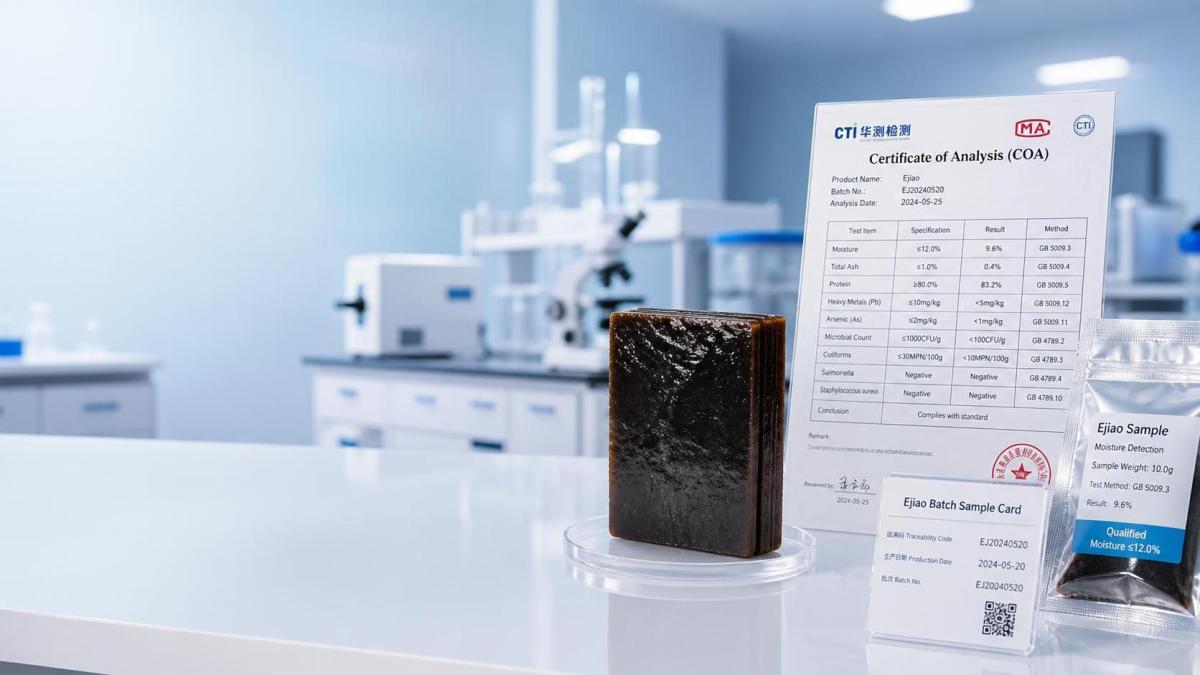
The first item to look for is a valid business and production qualification package from the source side, but the more important point is whether those records align with the actual product lot. A clean certificate on its own does not prove the ejiao block in hand is authentic. The batch number, production date, packaging code, and declared specifications should match across the label, COA, and any traceability record. If those identifiers drift, the paperwork may belong to another lot or another grade.
Traceability documents are especially important for animal-derived materials. For an ejiao block, the chain of custody should show the raw material source, intermediate processing steps, and the point at which the product became a finished block. If a supplier only provides a generic origin statement, that is usually not enough for internal control. A stronger record should indicate whether the material was extracted, concentrated, molded, dried, or otherwise processed, because each step can change moisture, viscosity, appearance, and microbiological risk.
Certificates related to quality management are useful, but only as a signal that a controlled system may exist. They do not replace product-specific evidence. For instance, a quality system certificate does not tell you whether the current ejiao block was tested for identity, heavy metals, or microbial limits. It simply suggests that documented procedures may be in place. The practical question is whether those procedures were followed for the exact lot being purchased.
Product-specific test reports are where most of the real decision value sits. The report should identify the sample, the testing method, the result, and the acceptance criteria. A report that lists only “qualified” without method names or numerical values leaves too much room for interpretation. When the matrix is a dense animal-derived block, the method matters because different assay techniques may produce different sensitivity for the same analyte.
Identity testing is one of the first reports to review. In this category, a laboratory may use methods such as microscopic inspection, peptide or protein-based analysis, chromatographic profiling, or other validated identity checks depending on the lab’s scope. The aim is to confirm that the material is consistent with ejiao and not a substituted gelatin, collagen mixture, or an overly processed lookalike. When identity evidence is weak, other results lose meaning because they may belong to the wrong substance.
Moisture or loss-on-drying data is also important for an ejiao block because water content affects stability, texture, and storage behavior. A block with excessive moisture can be more vulnerable to microbial growth, softening, deformation, or packaging issues during transport. A report should specify the method used, whether the sample was ground or tested as received, and what limit was applied. Inconsistent preparation can make two reports look comparable when they are not.
Assay or marker content reports deserve careful reading. Depending on the formulation, the report may measure gelatin-related markers, amino acid profile indicators, or other specified constituents used to characterize the product. The critical question is not whether a number is present, but whether the method is appropriate for a dense, processed matrix and whether the result fits the declared specification. If the specification is broad, the report may still be hard to use for lot-to-lot control.
Microbiological results are necessary when the product will be stored, transported, or held for a period before use. The report should cover at least the organisms and indicators relevant to the product category and local requirements, such as total aerobic count, yeast and mold, and any specific pathogens required by the applicable standard. An ejiao block may look dry and stable, but surface contamination, packaging leaks, or poor cooling during storage can still create risk. The report should also show the sample date, because older results do not reflect current condition.
Heavy metal data often appears in this file set, and it should be read with caution. The report should name the analytes and methods, not just list a generic compliance statement. For an animal-derived medicinal or health product, the concern is whether the numbers are reported against a clear limit and whether the lab appears to have used a suitable analytical technique. If the sample prep is not described, it is harder to judge how much confidence to place in the result.
Pesticide residue, veterinary drug residue, and other contaminant reports may be relevant depending on the origin of the raw material and the claims made for the finished block. Not every file set will contain all of these tests, but if the sourcing is unclear or the risk profile is elevated, the absence of these reports should not be treated casually. In practice, a narrow report set can be acceptable only when the residual risk has been assessed and documented.
Some documents are easy to overvalue. An attractive certificate format, a stamped page, or a generic compliance statement does not automatically make an ejiao block suitable. More weight should be given to reports from laboratories that identify the testing standard, instrument method, sample handling, and result date. A recent report is not automatically better than an older one unless the product lot is the same and storage conditions have not changed.
Sampling detail is another area where quality files often become thin. For solid blocks, the report should indicate whether the test portion came from the outer layer, the center, or a composite sample. That matters because drying, oxidation, and contamination can vary by location inside the block. If a supplier submits a report without sampling notes, the result may not represent the whole batch. This is especially important when the block is cut, repacked, or repurposed after initial release.
Packaging and transport records can support the certificate package, even though they are not certificates themselves. Temperature exposure, humidity, sealing integrity, and shipping duration can affect physical condition and some analytical results. A block that arrived with softened edges, condensation, or odor change should not be cleared on paperwork alone. The receiving record should be read together with the COA and any deviation note, because a clean certificate does not cancel a damaged shipment.
When the paperwork includes a conformity statement to a national, pharmacopoeial, or internal specification, the exact edition and clause matter. A report that says “meets standard” without naming the standard version is weak. Standards can change in wording, limit values, or methods, and an outdated reference can create false confidence. The same caution applies when a report mixes in-house methods with external methods but does not distinguish between them.
Internal audit files should keep the review logic simple and reproducible. First, confirm the product identity and lot consistency. Next, compare the declared specification with the test result. Then check whether the lab is named, the methods are stated, and the dates make sense for the batch cycle. If any of those steps fail, the file should be treated as incomplete even if the document set looks polished.
Common misreads happen when a single clean result is treated as proof of overall quality. One acceptable assay does not cancel a missing identity test. A passed microbial report does not offset an unclear origin statement. A traceability file without matching lot codes does not support release. For an ejiao block, the documents should form one coherent chain, not a stack of unrelated approvals.
When the evidence is thin, requesting targeted retesting is often more useful than asking for more certificates. A repeat identity test, moisture check, or contamination screen can resolve a real uncertainty faster than another generalized letter. The aim is to reduce ambiguity around the exact batch in hand. In regulated or audited settings, that is usually more defensible than relying on broad assurances.
Documentation review should end with a narrow question: does this file set support acceptance of this specific ejiao block under the applicable specification? If the answer depends on missing methods, mismatched lot numbers, or vague statements, the record is not strong enough yet. A reliable procurement file is not bulky; it is aligned, legible, and tied to the actual product.