
SEARCH
MESSAGE

Understanding how donkey hide gelatin is processed matters far beyond traditional ingredient knowledge. In pharmaceutical and health product settings, each production stage shapes purity, batch consistency, traceability, and risk control. From the first inspection of raw hides to the final release tests, donkey hide gelatin must be evaluated as a controlled material rather than a simple extract.
Why processing details deserve close attention
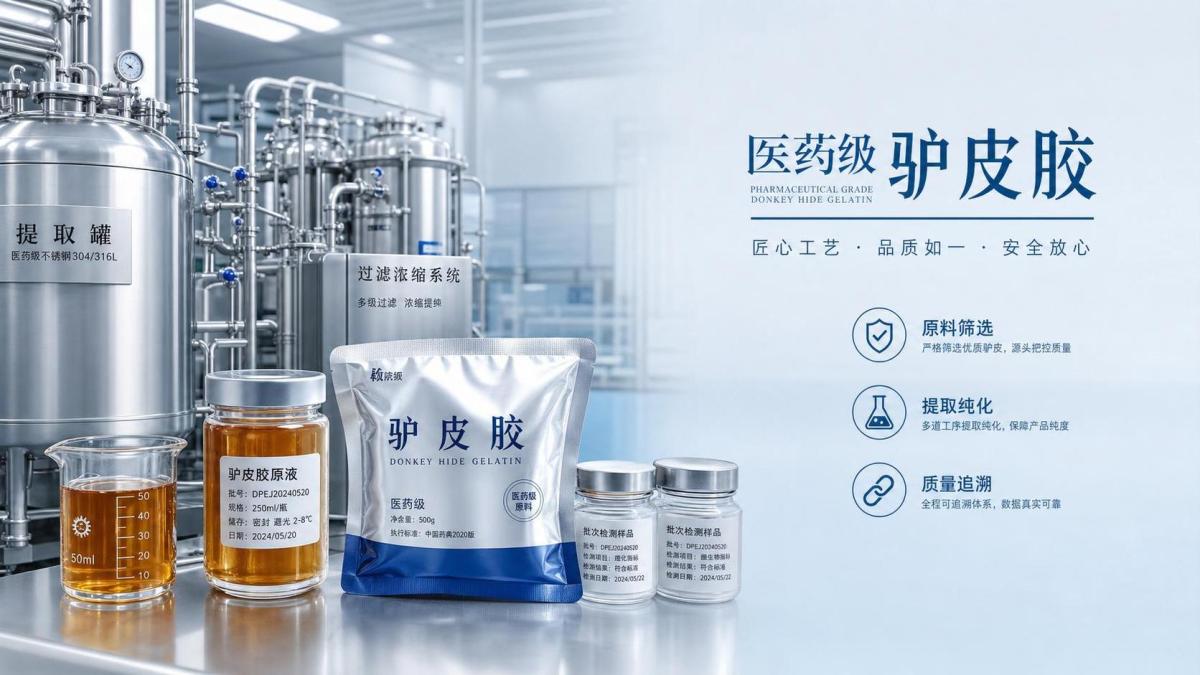
Donkey hide gelatin is used where stability and safety are closely linked to processing discipline. Small changes in raw material condition, extraction temperature, or concentration can alter viscosity, color, odor, microbial status, and downstream performance.
That is why process understanding supports more than manufacturing efficiency. It also helps determine whether a lot can meet internal specifications, pharmacopeial expectations, and market claims for health products.
Starting point: raw hide selection and traceability
The quality of donkey hide gelatin is heavily influenced by the incoming hide. Selection begins with verified sourcing records, animal origin documentation, transport conditions, and visible condition at receipt.
Well-managed facilities usually screen for hide thickness, freshness, decomposition signs, contamination, and foreign matter. Damaged, moldy, chemically tainted, or poorly stored hides increase the risk of off-odor, excessive ash, and unstable extraction results.
Traceability is equally important. A documented lot history makes it possible to investigate deviations, manage recalls, and connect final product quality back to a specific source and receiving decision.
What is commonly checked at intake
- Supplier qualification and origin records
- Appearance, odor, moisture, and visible cleanliness
- Storage temperature and transport integrity
- Evidence of unauthorized chemical treatment
- Lot coding for full chain traceability
Cleaning, trimming, and pretreatment
After acceptance, hides are trimmed and washed to remove dirt, blood residues, fat, and attached tissue. This is a practical control point because poor cleaning can carry contamination into later extraction stages.
Pretreatment often includes soaking and controlled pH adjustment. The purpose is to open the collagen structure, reduce unwanted components, and prepare the hide for efficient gelatin release.
Time, water quality, pH, and temperature all matter. Overly aggressive pretreatment may damage the desired protein fraction. Insufficient pretreatment can lower yield and leave impurities behind.
In health product manufacturing, this stage also influences sensory quality. Cleaner pretreatment usually leads to a more acceptable appearance and a more controlled final odor profile.
Extraction: where collagen becomes gelatin
The central transformation happens during extraction. Heat and water break down collagen from the pretreated hide and convert it into soluble donkey hide gelatin.
This stage is not simply a matter of boiling. Extraction temperature, cycle duration, solid-to-liquid ratio, and the number of extraction rounds all affect molecular profile and product consistency.
If the temperature is too low, the extraction may be incomplete. If it is too high, protein degradation can become excessive, reducing functional quality and creating darker color or altered texture.
Many manufacturers use staged extraction to balance yield with quality. Early fractions may show better clarity and stronger functional characteristics, while later fractions may require tighter review before blending.
Key process variables during extraction
Filtration, concentration, and refinement
Once extracted, the liquid passes through filtration and clarification steps. These stages remove insoluble particles and help improve transparency, purity, and microbial control.
Concentration follows, often under controlled thermal conditions or vacuum systems. The goal is to increase solids without causing unnecessary thermal damage.
Refinement may include decolorization, odor reduction, and impurity removal, depending on the required grade. This is often where the difference between acceptable and premium donkey hide gelatin becomes obvious.
A practical comparison can be seen in other traditional health products, including Black Sesame Pills, where raw material handling and concentration discipline also shape final consistency more than label claims alone.
Drying, shaping, and packaging controls
Before release, concentrated gelatin is dried into the intended physical form. Drying conditions affect moisture balance, storage stability, and susceptibility to microbial growth.
If moisture remains too high, caking, spoilage, and shortened shelf life become more likely. If drying is too harsh, brittleness, color change, and quality loss may appear.
Packaging is not a minor finishing step. Oxygen exposure, humidity control, sealing performance, and lot identification all support the long-term integrity of donkey hide gelatin in storage and distribution.
How final product quality is judged
Final quality review combines visual, chemical, microbiological, and documentation-based evaluation. The exact specification depends on intended use, but the same principle applies: process history must align with test data.
Common release indicators include appearance, odor, moisture, ash, protein-related characteristics, heavy metals, microbial limits, and residue control. Some facilities also monitor marker compounds or process-specific fingerprints.
Testing alone is not enough when process discipline is weak. A passing result from one batch cannot compensate for poor supplier management, inconsistent extraction records, or incomplete cleaning validation.
Useful quality checkpoints
- Check whether raw hide records match the finished lot code
- Compare extraction logs with batch-to-batch physical differences
- Review filtration and concentration deviations before release
- Confirm microbial data against drying and packaging conditions
- Assess whether specifications reflect actual use in medicine or supplements
Where problems usually emerge in practice
In real operations, quality failures rarely come from one dramatic mistake. More often, they result from several moderate weaknesses that pass unnoticed across different stages.
Typical warning signs include rising variability in color, unstable yield, recurring odor complaints, incomplete source files, and repeated rework after concentration or drying. These signals suggest that donkey hide gelatin control should focus on the full chain, not only the finished sample.
It is also useful to compare how process controls are applied across related health product categories. The same discipline that supports consistent donkey hide gelatin can strengthen review standards for products such as Black Sesame Pills when ingredient integrity and manufacturing records are under review.
A practical way to assess processing reliability
A reliable assessment starts with three connected questions. Is the raw hide source credible. Is the extraction process reproducible. Do final results reflect both process data and product specifications.
When these questions are reviewed together, donkey hide gelatin becomes easier to judge on evidence rather than tradition or appearance alone. That approach supports better release decisions, stronger audit readiness, and more meaningful supplier conversations.
The next useful step is to map each quality risk to a specific control point, from incoming hide checks to final packaging records. Once that map is clear, gaps in consistency, compliance, and product fitness are much easier to identify and address.